Minamoto no Yoritomo and Hojo Soun, Heroes Associated with Kamakura
 Lab 鎌倉奥乃院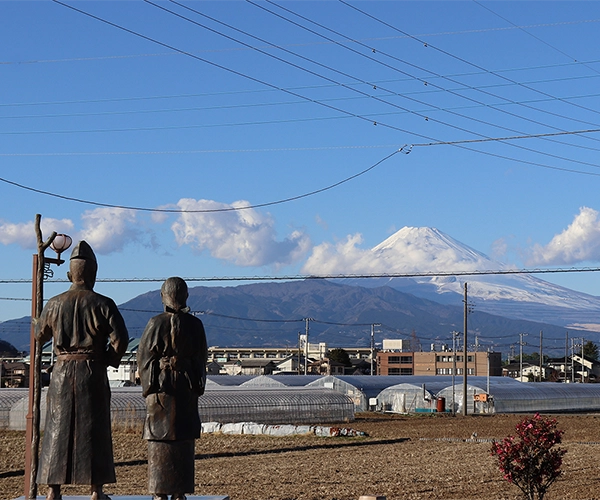
Minamoto no Yoritomo was the man who established Japan’s first samurai government. Hojo Soun was Japan’s first warlord. Both of these heroes have deep ties to Kamakura.
During Japan’s medieval period, there was another center of power besides Kyoto: Kamakura, the capital of the warrior class. Minamoto no Yoritomo marked the beginning of the era when Kamakura held political power, and Hojo Soun brought that era to a close.
Minamoto no Yoritomo
The photo above shows a view of Mount Fuji from Hirugakojima, where Minamoto no Yoritomo was exiled.
The two statues are of Yoritomo and Hojo Masako.
Before raising his army, Yoritomo must have always gazed upon this magnificent view. In other words, the majestic sight of Mount Fuji must have been etched in his mind.
Generally speaking, Minamoto no Yoritomo may not have a very favorable reputation. Many people likely view him as cold-hearted and ruthless. The reason for this is probably that he killed a great many people who tend to elicit public sympathy—including his younger brother Yoshitsune, Noriyori, his uncle Yukiie, his son-in-law Shimizu no Kanja Yoshitaka, his loyal vassal Kazusa-no-suke Hirotsune, and the child born to Yoshitsune and Shizuka Gozen. However, if we put ourselves in Yoritomo’s shoes and view him with sympathy, we can see that even his killings of Noriyori and Hirotsune were not entirely without extenuating circumstances.
There were two reasons for this. The first was that, as a boy, he had witnessed the gruesome death of his father, Yoshitomo, at the hands of a traitor. This incident must have deeply ingrained in the young Yoritomo’s mind the lesson that people cannot be trusted. The second was that his own child had been drowned in a river by Ito Sukechika. Is there anything in this world more precious and dear to a parent than their own child?
Therefore, if anyone were to exhibit even the slightest odd behavior or mannerisms, one might understand why Yoritomo would feel compelled to take immediate action—after all, if you put yourself in his shoes, you’d likely see that as unavoidable. As the proverb goes, “Once bitten, twice shy.”
However, it seems that the real Yoritomo was a kind-hearted man. While the fact that he helped Yorimori—the son of Nun Ike-no-Zenni who had saved him—does not in itself prove that he was a kind man, it does show that he was someone who properly repaid a debt of gratitude.
When Yoritomo was captured by Kiyomori and found himself in a desperate situation, it is said that he devoutly recited sutras and carved memorial tablets for his deceased father and brothers. Moved by this sight, Nun Ike-no-Zenni interceded on his behalf and pleaded with Kiyomori to spare his life.
Thanks to Nun Ike-no-Zenni, Yoritomo narrowly escaped certain death and was exiled to Izu, where he would live for the next twenty years until he raised an army. During this time, he was supported both materially and emotionally by Hiki-ni, who had been his wet nurse. Consequently, once he had gained power in later years, Yoritomo treated Hiki-ni’s children with great favor.
Yoritomo seems to have been a deeply filial man. Although this occurred after he had already seized control of the realm, it is said that he summoned his father Yoshitomo’s wet nurse—an elderly woman nearing her ninetieth birthday—and, as she recounted stories of his father’s past, wept profusely. Furthermore, it is said that during his exile in Izu, he chanted Buddhist prayers every day for his father, Yoshitomo, and for Masakiyo Kamata, a retainer who had died alongside his father. He also showed great gratitude toward his own retainers, such as Miura Daisuke and Sanada Yoichi.
From the moment he was born, Yoritomo was a man of boundless vigor, yet he was also a great hero whose kindness was as vast as the ocean.
Hojo Soun
The following photo shows the ruins of Nirayama Castle(韮山城), the stronghold of Hojo Soun, as viewed from Hirugakojima.
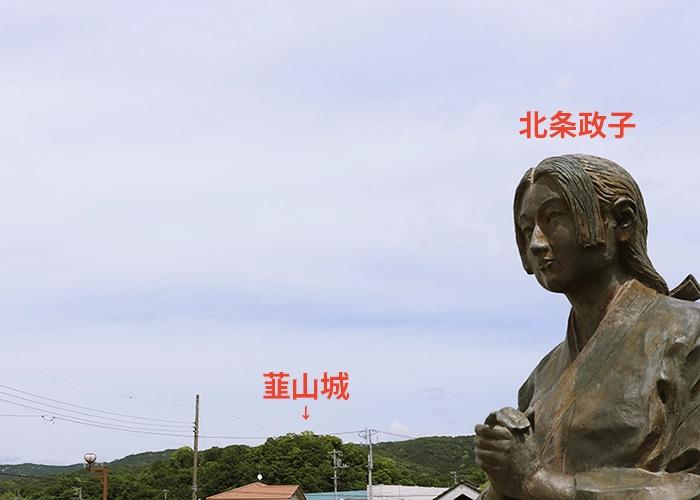
As you can see, Nirayama Castle is just a stone’s throw away from Hirugakojima, where Minamoto no Yoritomo was exiled.
There is no doubt that Hojo Soun, too, gazed upon the same majestic view of Mount Fuji that Minamoto no Yoritomo had once beheld.
Nirayama Castle was the main stronghold of the Later Hojo clan prior to their move to Odawara. Although it was Ujitsuna—Soun’s successor—who first adopted the name “Hojo,” the clan held the Kamakura Hojo clan in the highest regard.
In a sense, the “Neo-Hojo clan” attacked the Ashikaga clan (Chachamaru) at the Horigoe Residence, which was just a stone’s throw away, then moved eastward to build a castle in Kamakura (Tamanawa Castle). Just as the Kamakura Hojo clan had done to the Miura clan—a prominent family since the time of Yoritomo—they attacked and annihilated them, finally transforming themselves into a warlord of the Warring States period.
What kind of man was Hojo Soun? When evaluating a person, it is sometimes easier to understand them by looking at a single portrait than by reading lengthy descriptions. This is certainly true of Soun, and that portrait is the “Statue of Hojo Soun” located at Soun-ji Temple in Hakone. That stern countenance speaks more eloquently than anything else of the formidable intellect he possessed.
It is said that Soun kept a watchful eye on every nook and cranny of the castle, even observing the work of the maidservants who cooked the meals. He was also reportedly an extremely frugal man; there is a story that he hoarded even sewing needles to the point of piling them up in the storehouse. Otherwise, he could never have set out from Bitchū (present-day Okayama Prefecture) and brought the regions of Izu and Sagami in the Kanto under his control.
It is said that Soun, entering Kamakura in high spirits, sang that he would “restore Kamakura to its former glory as the capital”; yet Dosun, the defeated head of the Miura clan, sang with bitter resignation that both those who kill and those who are killed are nothing but “clods of earth.”
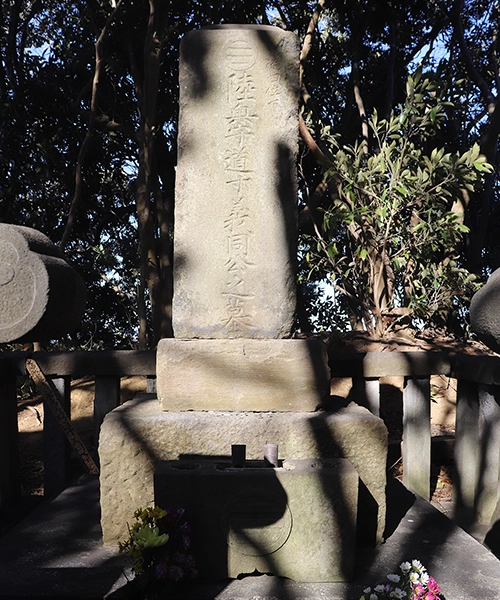
The following photo shows the grave of Miura Dosun on the Miura Peninsula. Whenever I visit, the sound of the sea echoes sadly.
A Guide to Easy-to-Read Books on Kamakura
The books below, produced by Lab Deep in Kamakura, provides an accessible introduction to Kamakura from a variety of perspectives.
“The Key to Kamakura” Author:Hisashi Toda
Kamakura is like a green box. Open its lid with the key and explore what's inside! You'll find many stories inside.
This book is an introductory guide to Kamakura. Nevertheless, it reveals Kamakura's multifaceted, mosaic-like nature.
It is an in-depth sightseeing guidebook, and we have included as many photos as possible, making them easy to view.
Table of Contents:
1. Middle Ages
2. Boundary Points
3. Yoritomo (源頼朝)
4. Sanetomo (源実朝)
5. The Great Buddha (大仏)
6. Author
7. Abutsuni (阿仏尼)
8. Yasujirō Ozu (小津 安二郎)
9. Actress
10. Sea
11. Enoshima (江の島)
12. Gardens
If you are considering a purchase, please click the button below.
“KAMAKURA” Author:Yone Noguchi
This is a guidebook to Kamakura by Yone Noguchi(野口米次郎), one of Japan's greatest heroes. However, unlike ordinary guidebooks, it reveals the true face of Kamakura: a city of silence, history, and Buddhism.
Table of Contents:
BY THE ENGAKUJI TEMPLE
THE TEMPLE OF SILENCE
A LEGEND OF THE BUDDHA'S TOOTH
BY A BUDDHA TEMPLE
UNDISCOVERED KAMAKURA
THE WONDER OF BRONZE
BY THE DAIBUTSU AT KAMAKURA
NICHIREN
THE HACHIMAN SHRINE
ENOSHIMA
If you are considering a purchase, please click the button below.
Lab Deep in Kamakura Juei Masuda