The Kamakura Museum of National Treasures
 Lab 鎌倉奥乃院
National Treasures in Kamakura
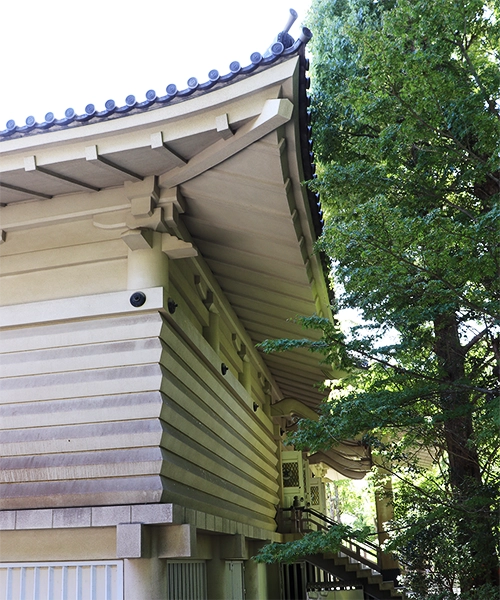
Kamakura is a historic city, so it's no surprise that there are quite a few cultural properties designated as national treasures. However, the Great Kanto Earthquake damaged many of these properties. In an effort to protect these treasures from future disasters, The Kamakura Museum of National Treasures was built in 1928, almost 100 years ago.
The exterior, made of reinforced concrete, is said to be modeled after the Shosoin Repository in Nara.
By the way, the grand annual festival is held every September at Tsurugaoka Hachimangu Shrine. During this time, The Kamakura Museum of National Treasures displays its entrusted national treasures, including swords and inkstone boxes associated with Minamoto no Yoritomo.
For example, when I see the beauty of these crafts decorated with mother-of-pearl inlay, I am not simply moved by their beauty, but I think of the skill and aesthetic sense of the creators of the time, and I can't exaggerate enough to say that my eyes well up with tears.

"The older, the better," said Yasunari Kawabata, one of Kamakura's great writers. Once inside this museum, I found myself agreeing with him.
Yasunari Kawabata's works evoke the faint glow of Japan's medieval era. However, my first encounter with that medieval feeling was the Nintojo (Staff of Two Heads), which is permanently displayed in this museum. I sense it particularly in the face of the "Kokuanten."
The Great Kanto Earthquake and Minamoto no Sanetomo's Poem
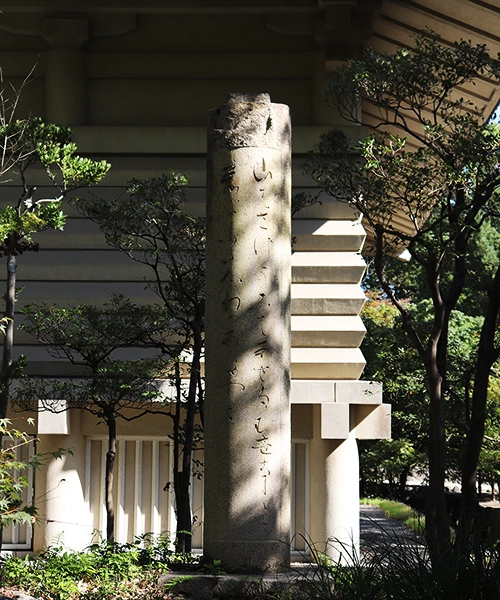
The exhibits are worth seeing, but the building itself is also worth seeing. Of course, it is a nationally registered tangible cultural property.
Just outside the building, as shown in the photo above, stands the leg of the second torii gate of Tsurugaoka Hachimangu Shrine, which collapsed during the Great Kanto Earthquake. Engraved upon it is Minamoto no Sanetomo's famous poem, “The mountains split apart…”—likely an homage to Emperor GoToba, with whom he was allied at the time. As a poem inscribed on a leg broken by the earthquake, I find it most fitting.
A Guide to Easy-to-Read Books on Kamakura
The books below, produced by Lab Deep in Kamakura, provides an accessible introduction to Kamakura from a variety of perspectives.
“The Key to Kamakura” Author:Hisashi Toda
Kamakura is like a green box. Open its lid with the key and explore what's inside! You'll find many stories inside.
This book is an introductory guide to Kamakura. Nevertheless, it reveals Kamakura's multifaceted, mosaic-like nature.
It is an in-depth sightseeing guidebook, and we have included as many photos as possible, making them easy to view.
Table of Contents:
1. Middle Ages
2. Boundary Points
3. Yoritomo (源頼朝)
4. Sanetomo (源実朝)
5. The Great Buddha (大仏)
6. Author
7. Abutsuni (阿仏尼)
8. Yasujirō Ozu (小津 安二郎)
9. Actress
10. Sea
11. Enoshima (江の島)
12. Gardens
If you are considering a purchase, please click the button below.
“KAMAKURA” Author:Yone Noguchi
This is a guidebook to Kamakura by Yone Noguchi(野口米次郎), one of Japan's greatest heroes. However, unlike ordinary guidebooks, it reveals the true face of Kamakura: a city of silence, history, and Buddhism.
Table of Contents:
BY THE ENGAKUJI TEMPLE
THE TEMPLE OF SILENCE
A LEGEND OF THE BUDDHA'S TOOTH
BY A BUDDHA TEMPLE
UNDISCOVERED KAMAKURA
THE WONDER OF BRONZE
BY THE DAIBUTSU AT KAMAKURA
NICHIREN
THE HACHIMAN SHRINE
ENOSHIMA
If you are considering a purchase, please click the button below.
Lab Deep in Kamakura Juei Masuda