The “Kamakura History and Culture Exchange Center”: A Premier Kamakura-Style Space
 Lab 鎌倉奥乃院
“Kamakura History and Culture Exchange Center”: Its Architectural Beauty
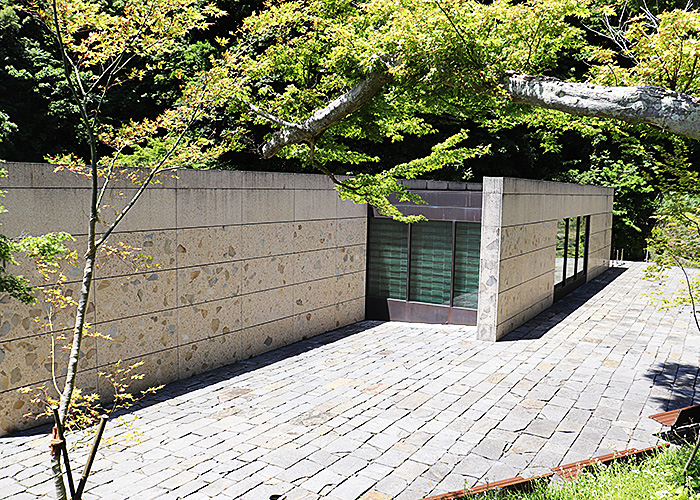
This museum was once a private residence, so visitors should keep that in mind before entering.
As you explore the museum, keep in mind that this building was designed by the renowned British architect Norman Foster.
Mr. Foster gained fame with the Hong Kong and Shanghai Banking Corporation headquarters (1986) and has continued to lead the global architectural world ever since; since 2000, he has designed projects such as Apple Park, Apple’s massive doughnut-shaped new headquarters—often referred to as the “spaceship”—which was completed in 2017.
As mentioned above, the building that now houses the Kamakura History and Culture Exchange Center was originally constructed as a private residence in 2004. Drawing on Kamakura’s history dating back to the medieval period and taking into account the Japanese aesthetic sensibility, the architectural concept was “harmony between nature and artificiality.”
While human endeavors often fail to align intentions with results, in the case of this building designed by Mr. Foster, the concept and the result are in perfect harmony.
“Kamakura History and Culture Exchange Center”: The Beauty of the Ruins Along Its Perimeter
The items on display here—such as swords by Masamune, a Kamakura-period swordsmith active since the Middle Ages, numerous archaeological finds, and photographic panels—as well as the many exhibits in the special exhibitions, which change themes from time to time to delight us, always stimulate a certain part of my brain and make me feel as if I’m traveling through time and space. (I especially love the VR experience in the entrance hall—you can fly through the sky.) But in fact, there are plenty of highlights not only inside the museum where the exhibits are displayed, but also outside.
This museum is located in “Chibagaya,” one of the many valleys found throughout Kamakura. The name “Chibagaya” is said to derive from the fact that the residence of the Chiba clan—a powerful samurai family based in what is now Chiba City, Chiba Prefecture—once stood somewhere within this valley. This valley is also known as “Muryojigaya,” and as the name suggests, a temple called Muryoju-in once stood on the site where the Kamakura History and Culture Exchange Center now stands. Muryoju-in appears to have been the family temple of the Adachi clan, a powerful retainer family. The Azuma Kagami records that a memorial service marking the 13th anniversary of the death of Yoshikage Adachi was held at this temple.
Incidentally, Yoshikage Adachi was the son of the formidable Kagemori Adachi, and he fought alongside his father to destroy the Miura clan in the Battle of Hoji.
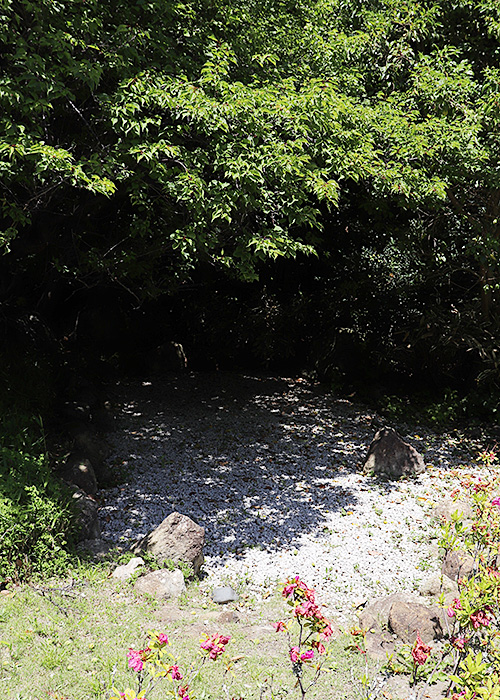
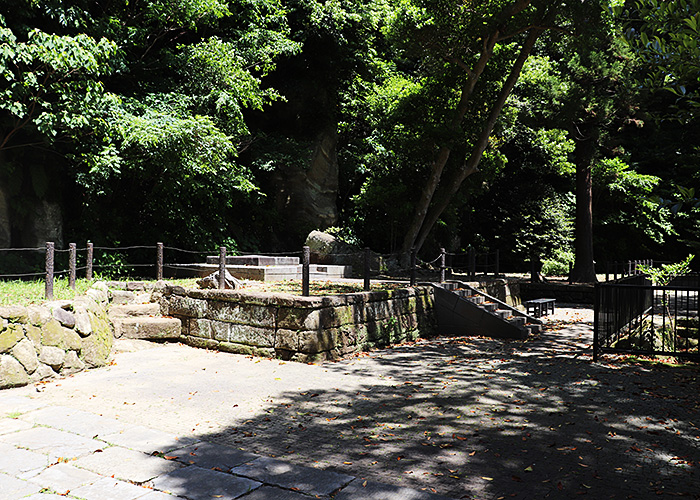
While converting a private residence into a museum, the remains of a pond lined with gravel were unearthed. It is said to have been an elegant pond complete with a yarimizu stream and a central island, and is believed to date from the late Kamakura period, making it one of the oldest medieval gardens in Kamakura. Although the excavated pond has been relocated to another area within the same Kamakura History and Culture Exchange Center (as shown in the photo above), its original site was situated at the base of a steep cliff—a common feature in Kamakura. The garden style, which incorporates the rocky face of the cliff as a borrowed landscape, is said to share similarities with the garden at Zuisenji Temple, which is renowned for having been designed by the monk Muso Soseki.
Water was channeled into the pond via a yarimizu stream, but the source of the water was apparently spring water seeping from the rock face high up on the cliff. This spring water still flows today, and you can see several yarimizu streams running down the rock face, as well as a few pools that could almost be called ponds.
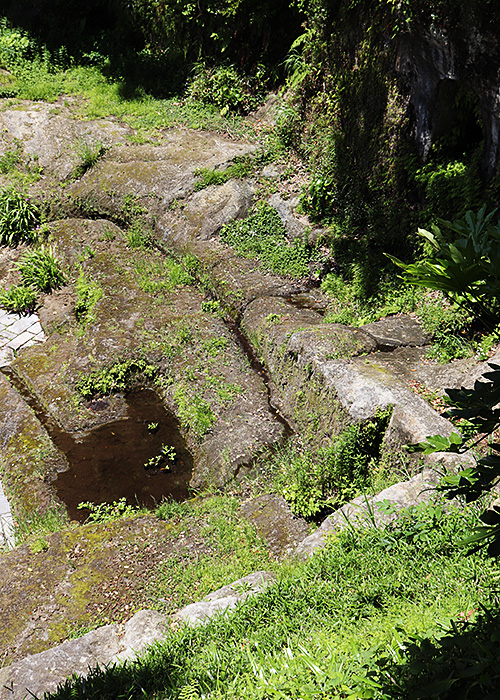
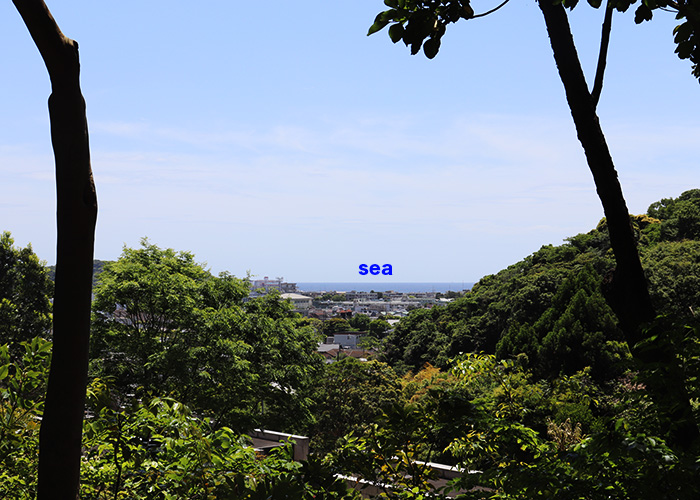
The top of this cliff is now a lookout point, offering a splendid view of the blue sea beyond the green valley. However, this site was once home to the “Yaiba Inari(Swordsmith Inari) ” shrine, which was dedicated to protecting swordsmiths. The reason for this is that, during the Edo period, the estate of a descendant of Masamune—a swordsmith of the Soshu school—stood on this very spot, where Muryoju-in Temple once stood.
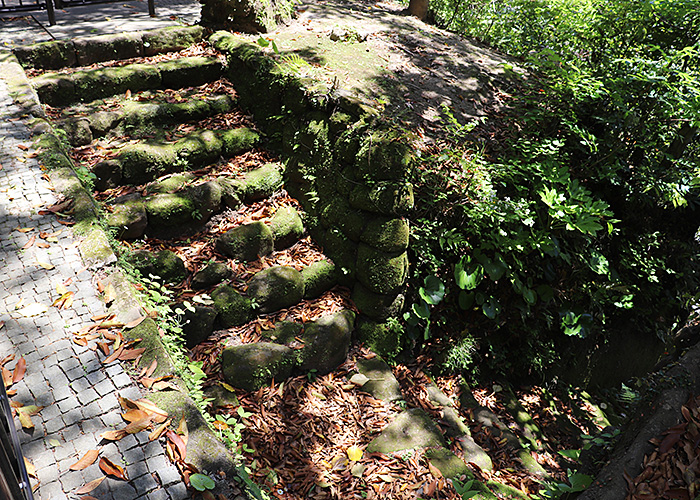
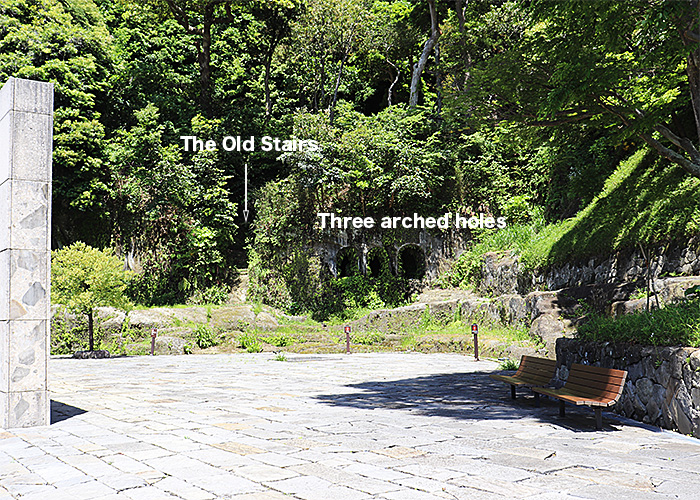
You can still see the steps leading up to the shrine, though they’ve weathered quite a bit and their edges have become rounded. I was told that, since the blacksmith had work to do during the day, he would pay his respects at night—which makes sense, as you can see a single weathered lantern on either side of the steps.
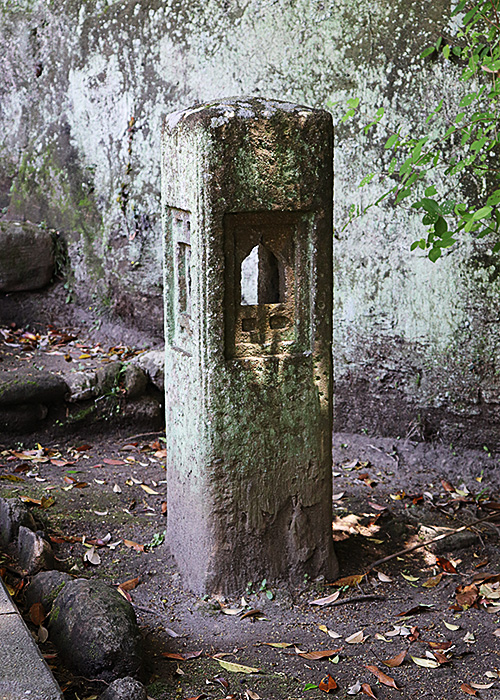
During the Taisho period, the Iwasaki family of the Mitsubishi Zaibatsu used this area as a vacation home. It is said that they restored the Yaiba Inari shrine, which had originally been enshrined here, as the new “Aizuchi Inari” shrine, and constructed the approach path and torii gate.
Note that the shrine buildings and torii gates have been relocated to the nearby Kuzuharaoka Shrine, which is dedicated to the ill-fated nobleman Hino Toshimoto.
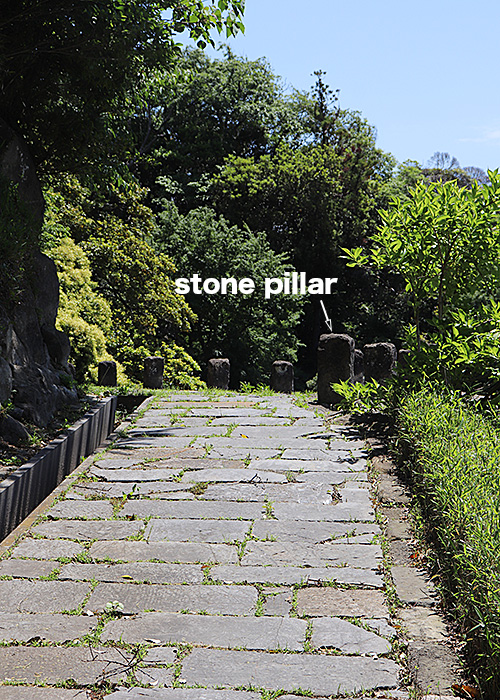
At the Kamakura History and Culture Exchange Center, you can also see medieval yagura (tombs), arched horizontal holes believed to have been built during the Iwasaki family’s ownership—which may have served as storage areas or been intended to enhance the beauty of the garden—as well as stone pillars lined up at regular intervals along the edge of the path, presumably to prevent people from falling off the cliff.
The Kamakura History and Culture Exchange Center stands firmly rooted in the long span of time encompassing Kamakura’s medieval, early modern, and modern eras.
A Guide to Easy-to-Read Books on Kamakura
The books below, produced by Lab Deep in Kamakura, provides an accessible introduction to Kamakura from a variety of perspectives.
“The Key to Kamakura” Author:Hisashi Toda
Kamakura is like a green box. Open its lid with the key and explore what's inside! You'll find many stories inside.
This book is an introductory guide to Kamakura. Nevertheless, it reveals Kamakura's multifaceted, mosaic-like nature.
It is an in-depth sightseeing guidebook, and we have included as many photos as possible, making them easy to view.
Table of Contents:
1. Middle Ages
2. Boundary Points
3. Yoritomo (源頼朝)
4. Sanetomo (源実朝)
5. The Great Buddha (大仏)
6. Author
7. Abutsuni (阿仏尼)
8. Yasujirō Ozu (小津 安二郎)
9. Actress
10. Sea
11. Enoshima (江の島)
12. Gardens
If you are considering a purchase, please click the button below.
“KAMAKURA” Author:Yone Noguchi
This is a guidebook to Kamakura by Yone Noguchi(野口米次郎), one of Japan's greatest heroes. However, unlike ordinary guidebooks, it reveals the true face of Kamakura: a city of silence, history, and Buddhism.
Table of Contents:
BY THE ENGAKUJI TEMPLE
THE TEMPLE OF SILENCE
A LEGEND OF THE BUDDHA'S TOOTH
BY A BUDDHA TEMPLE
UNDISCOVERED KAMAKURA
THE WONDER OF BRONZE
BY THE DAIBUTSU AT KAMAKURA
NICHIREN
THE HACHIMAN SHRINE
ENOSHIMA
If you are considering a purchase, please click the button below.
Lab Deep in Kamakura Juei Masuda