The Moon on Earth, the Unrestrained Poet Saigyo
 Lab 鎌倉奥乃院
“On Saigyo” written by Yonejiro Noguchi
Before Saigyo(西行) became a monk, he was a samurai named Sato Norikiyo. As a descendant of the famous Fujiwara Hidesato, also known as Tawara Tota, he was no ordinary samurai. He was from a distinguished family. However, Norikiyo threw away his promising future and took up a life of misery, carrying only a hat and a walking stick. And all at the young age of 23.
His courage is nothing short of amazing. For someone like Sato Norikiyo, who served as a close attendant to the Imperial Court at the time, becoming a monk would have been a much more familiar option than it is for us today, and even though Norikiyo had an episode in which he faced the winds of impermanence with the sudden death of his best friend, there is a high barrier between wanting to do something and actually acting on it, so Norikiyo's unity of knowledge and action is nothing short of amazing.
Saigyo lived a long life for his time, and his lifetime included the Hogen Rebellion, the Heiji Rebellion, the Genpei War, and the Battle of Oshu. Saigyo generally had connections with the losing side in these wars. One of the most famous episodes is when he was close friends with Taikenmonin(待賢門院) and Emperor Sutoku(崇徳院). As is well known from Ueda Akinari's Tales of Moonlight and Rain(雨月物語), Saigyo visited the grave of Emperor Sutoku, a place that no one else had visited due to the circumstances of the time. Saigyo was a loyal man, which may have stemmed from his former life as a samurai.
This is purely my own opinion, but when I think about the famous meeting between Saigyo and Minamoto no Yoritomo in Kamakura, I think Saigyo had the purpose of pleading for the lives of Yoshitsune and others to be spared. When this ended unsuccessfully, Saigyo may have become enraged and given the silver cat, which was a special gift from Yoritomo, to a child.
After the meeting, Sato Tadanobu, a relative of Saigyo and a retainer of Yoshitsune, and the Oshu Fujiwara clan, who were also relatives of Saigyo, were annihilated by Yoritomo. Yoshitsune, who had sought refuge with the Oshu Fujiwara clan, was also killed.
Perhaps the reason he went alone to meet Yoritomo was due to his sense of chivalry as a former samurai.
There are few historical figures who can offer guidance to me as I live today, but Saigyo, who fully understood the meaning of freedom, lived to a ripe old age, and ended his life well, has given me courage and many other things.
By the way, I would like to mention one more great person here.
That person is Yonejiro Noguchi.
He traveled to America during the Meiji era, lived there for many years, and became deeply knowledgeable about both Eastern and Western cultures.
Incidentally, he is also the father of Isamu Noguchi.
Yonejiro Noguchi is also a poet, and among his many works is one written about Saigyo. It is a masterpiece.
“On Saigyo(西行論)” written by Yonejiro Noguchi(野口米次郎)
https://www.amazon.co.jp/dp/B0GJ114SW2
Here's just a brief excerpt.
「月は樹木の挨拶にも答ヘずにさっさと上ってゆく。山にも丘にも月を捕へる力がない。雲でも月にかかるとするりと逃げられて仕舞ふ。・・・略・・・現実世界をするりと逃れて詩歌の法悦に遊ぶ西行は確かに地上の月だ。」
The meaning is as follows.
The moon ascends swiftly, not even answering the trees' greetings. Neither mountains nor hills possess the power to capture it. Even clouds, when they try to grasp the moon, slip away effortlessly. …[omitted]… Saigyo, who slips away from the real world to revel in the ecstasy of poetry, is truly the moon upon the earth.
This book is available as an e-book (a paperback version is also available). If you're interested, please click the URL above. You will be redirected to the purchase page on Amazon.
However, this book is written in Japanese.
Shigitatsuan
Shigitatsuan(鴫立庵) is located in Oiso Town, Kanagawa Prefecture. Facing the beautiful Tokaido road lined with pine trees, it lies along the course of the Hakone Ekiden relay race held on the second and third days of the New Year. Yet, despite this bustle, the place itself is utterly silent.
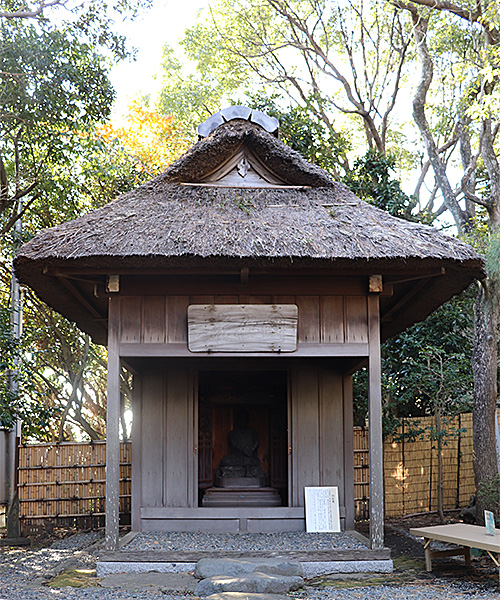
Once you arrive there, thatched-roof buildings will welcome you.
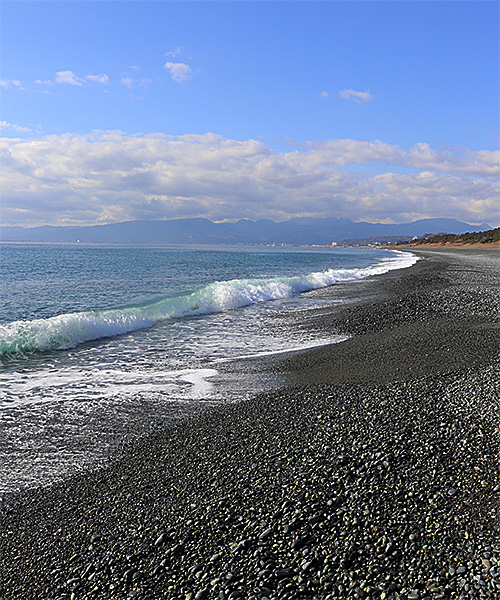
Just behind it lies the sea, and it is said that this is where Saigyo composed one of his most celebrated poems, “鴫立つ沢.”
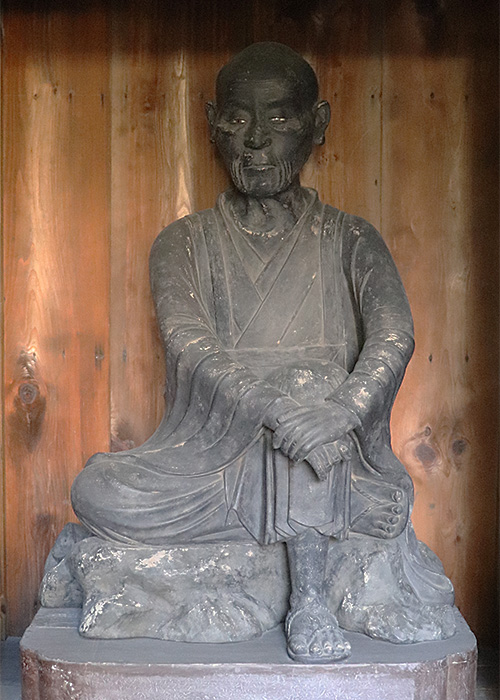
The statue of Saigyo is enshrined inside the thatched hall called “Enido(円位堂).”
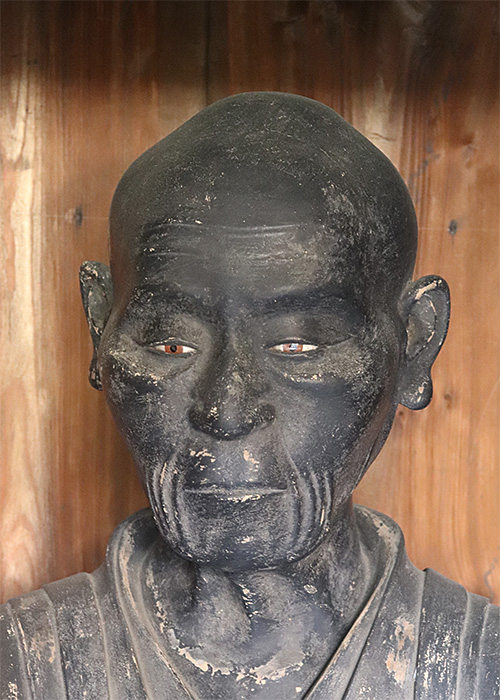
The hall is said to have been built during the Genroku era, but the exact date of creation for the statue of Saigyo with its inlaid glass eyes is unclear. Some theories suggest it may date back to the Muromachi period or even earlier.
In any case, Saigyo's face is truly dignified. It seems fitting for a wandering poet. Moreover, one senses the extraordinary talent of the creator who posed him with one leg raised and both hands clasped around his knees.
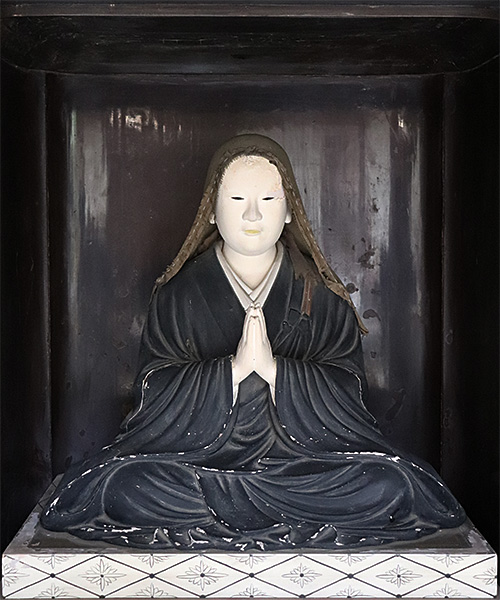
Additionally, Shigitatsuan also houses a statue of Toragozen(虎御前). This wooden statue is said to depict Toragozen, the lover of Soga Juro, the protagonist of the famous revenge tale “The tale of Soga,” at the age of nineteen.
Lab Deep in Kamakura Juei Masuda