Kamakura and Koga: The Birthplaces of Japan’s Warring States Period
 Lab 鎌倉奥乃院
Contents
When and where did Japan’s Warring States period begin?
It is generally accepted that the Warring States period began with the Onin War, but there are actually various theories on the matter, and the view that the Kyotoku Rebellion marks its beginning is also widely held.
Since the Kyotoku Rebellion actually broke out more than ten years before the Onin War, if this theory is correct, it means that the Kanto region entered the Warring States period before the Kansai region did.
The “Kyotoku Rebellion” broke out after Ashikaga Shigeuji, the Kamakura Kubo, killed Noritada—the son of Uesugi Norizane, the Kanto Kanrei—in Kamakura. As for why Noritada had to be killed, it was because Ashikaga Shigeuji blamed Uesugi Norizane for the death of his father, Ashikaga Mochiuji, who had been killed in the “Eikyo Rebellion” that had occurred in Kamakura earlier. Therefore, it seems Shigeuji killed Norizane’s son, Noritada, as a way to vent his frustration.
The Muromachi period can be viewed, in part, as an era of conflict between the Kyoto shogunate and the Kamakura government, stemming from the fact that Ashikaga Takauji, the first shogun, established the shogunate in Kyoto rather than Kamakura, and set up the Kamakura government in Kamakura. However, during the reign of Mochiuji, the fourth Kamakura Kubo, the Kyoto shogunate and the Kamakura government finally came to blows.
Uesugi Norizane, the Kanto Kanrei who was supposed to assist Ashikaga Mochiuji, the Kamakura Kubo, appears to have struggled greatly in mediating between the shogunate in Kyoto and Mochiuji; although he ultimately attacked and killed Mochiuji, it does not seem that he did so willingly.
Uesugi Norizane. He appears to have been a man of great character and is known for reviving the Ashikaga School. After his son, Noritada, was killed, he fled to Kyushu to escape the turmoil in the Kanto region. There, he sought refuge with Ouchi Norihiro, retired from public life, and devoted the remainder of his days to Buddhist practice. He reportedly died in 1466 at Taineiji Temple in Yamaguchi Prefecture—the very place where the Ouchi clan would later meet its demise.
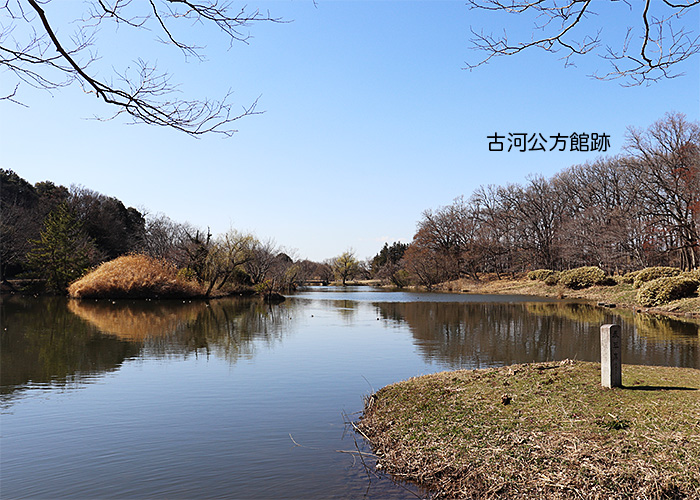
Now, Ashikaga Shigeuji, the fifth Kamakura Kubo who had killed Uesugi Noritada (the son of Uesugi Norizane), was attacked by Noritada’s younger brother, Fusaaki—who was backed by the shogunate in Kyoto—and reinforcements led by Imagawa Noritada. As a result, he fled Kamakura and relocated his base to Koga (Ibaraki Prefecture). Shigeuji ceased to be the Kamakura Kubo and from this point on came to be known as the “Koga Kubo.” After Shigeuji moved to Koga, the Kanto region descended into utter chaos, and the region finally plunged into the Warring States period.
The Koga Kubo, with Shigeuji as its first head, lasted for approximately 130 years until the fifth head, Yoshiuji. With Shigeuji’s relocation to Koga, the culture of Kamakura was transplanted there, leading to a period of prosperity that could be described as a “second Kamakura”; even today, many temples and shrines associated with Kamakura remain within the city limits of Koga.
By the way, I think it’s generally accepted that Japan’s first warlord was Hojo Soun, also known as Ise Sozui.
Hojo Soun raised an army in Izu, seized control of Kamakura, drove the Miura clan—a prominent family of the Miura Peninsula—to the southern tip of the peninsula and annihilated them, and subjugated the provinces of Izu and Sagami. I would like to draw attention to the fact that Soun was the first warlord. If he was the first warlord, does this not suggest that the Warring States period first began in the Kanto region? In other words, I believe the Warring States period originated with the “Kyotoku Rebellion” or the “Eikyo Rebellion,” and that with the emergence of Hojo Soun as a warlord, the Kanto region was the first in the country to fully transition into the Warring States period. The work Hojo Soun accomplished can be seen as providing a definitive resolution to the series of disturbances that followed the “Eikyo Rebellion” in Kamakura.
However, the theory above is merely a hypothesis. There are certainly some points of doubt.
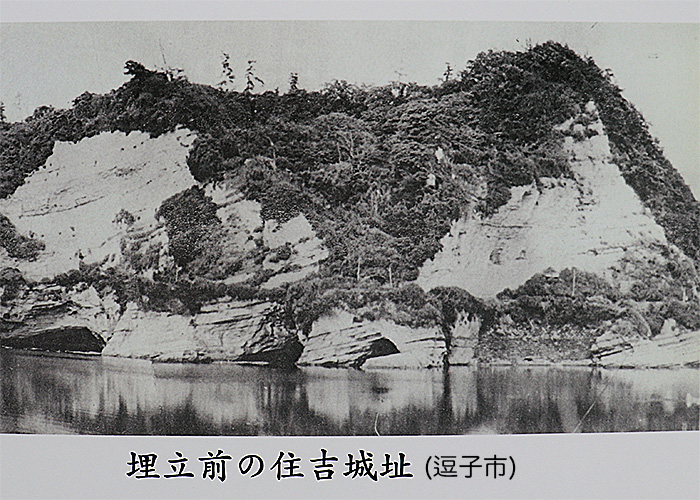
The image above shows the ruins of Sumiyoshi Castle, located near the border between Kamakura and Zushi. It is said that Hojo Soun attacked the Miura forces based here (though there are various theories). As shown in the image, the site was once surrounded by the sea, but the area that used to be the sea has since been reclaimed.
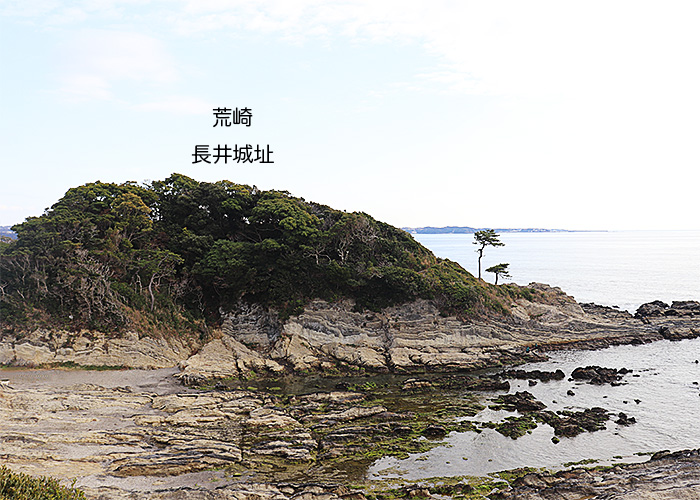
The image below shows another castle owned by the Miura clan; like Sumiyoshi Castle, it is a romantic castle surrounded by the sea.
I wrote “romantic,” but when I think of days gone by, I find myself captivated by the romantic image of being inside a castle and hearing the sound of the waves.
Ashikaga Shigeuji, the Kamakura Kubo who instigated the “Kyotoku Rebellion” in Kamakura, moved to Koga and became the Koga Kubo. As a result, Kamakura's culture was transplanted to Koga, and over the course of five generations of Koga Kubo—a period of approximately 130 years—Koga emerged as a major political center in the Kanto region.
If the Kyotoku Rebellion marked the beginning of Japan’s Warring States period, then one might say that its birthplace was either Kamakura or Koga.
Michiko Nagai, a great writer with ties to Kamakura and Koga
Michiko Nagai is, of course, a renowned master of historical novel, and I find it particularly fascinating that she has been named an honorary citizen of both Kamakura and Koga. Furthermore, I am delighted that this has served as the catalyst for Kamakura and Koga to sign a “Cultural and Tourism Exchange Agreement.”
History is a chain of events. The heroes of old are surely connected to Michiko Nagai as well. And perhaps, through Ms. Nagai’s work, we too can find a connection to those heroes somewhere.
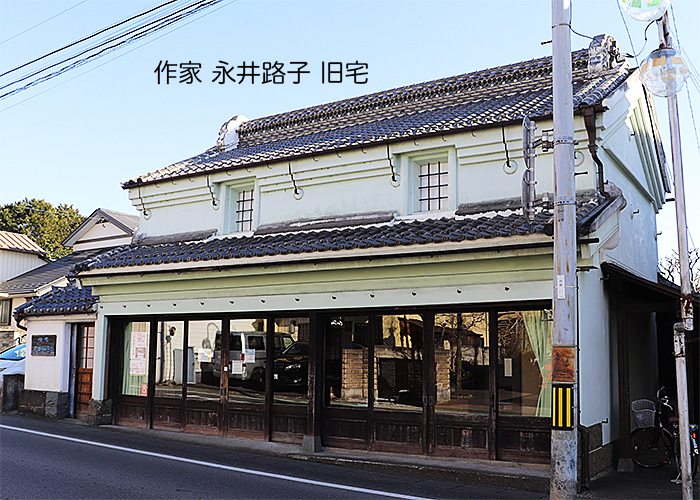
The photo below shows Michiko Nagai’s former home. It is said that Ms. Nagai lived here from the age of three until she was twenty.
Lab Deep in Kamakura Juei Masuda