Eating the rivals of “Edo-mae” (Tokyo Bay) fishing!
 Lab 鎌倉奥乃院
Back when Tokyo was known as Edo, Tokyo Bay and the Sumida River, along with other waterways, must have been a veritable paradise for anglers.
There were far more fish swimming there than there are today, and “aogisu”(blue whiting) that are now extinct were still thriving.
The shirogisu(white whiting) is still thriving today, and like a lotus blooming from the mud, it delights us with its beautiful, pearl-like body.
Edo-mae(Tokyo Bay) fish. That includes shirogisu(white whiting), of course, as well as conger eel, big-eyed flathead, flounder, Konoshiro, and so on. If we even include fish like the Ginpo—a staple of high-end tempura—a truly vast array of species comes to mind. However, here I’d like to focus specifically on three fish that are particularly familiar to us and renowned as formidable fishing opponents: the sea bass (known as “suzuki”), the black sea bream (known as “chinu” in the Kansai region and “Kaizu” in Edo), —and the mullet, which somehow feels like it has long since fallen out of favor as a target for anglers. I would like to limit my thoughts here to these three fish.
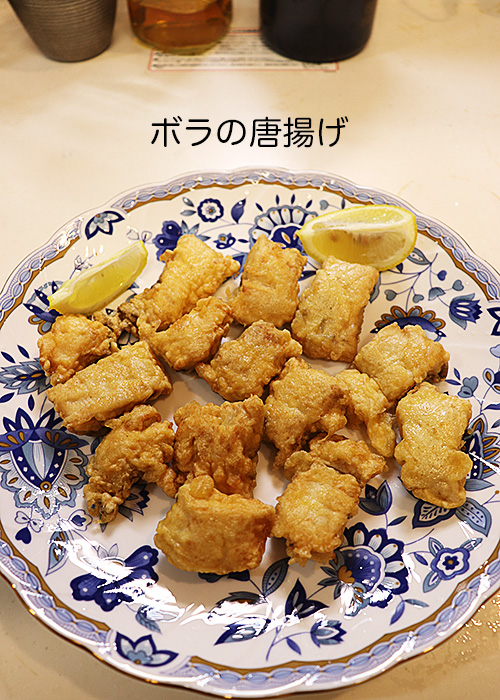
Let’s eat mullet!
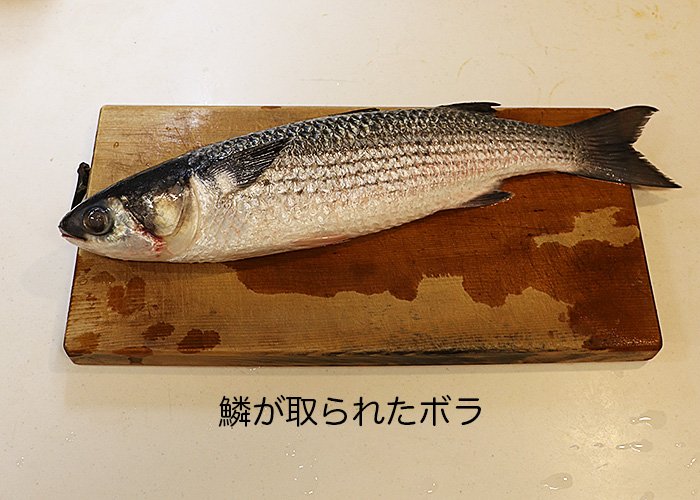
The mullet in the photo above isn’t one I caught. It was for sale at a fish market.
These days, when I go to the fish section of a supermarket, the selection is so limited that it really saddens me. However, this fish market is one of the few places I’m grateful for—it’s a rare gem. In addition to the mullet shown in the photo, they carried a wide variety of fish, including horse mackerel, mackerel, and sardines, of course, as well as young yellowtail, gurnard, girella, rockfish, black sea bream, sea bass, red sea bream, Spanish mackerel, and even striped jack. All of them were sold whole, with heads and tails intact.
So, of all these, excluding horse mackerel, mackerel, and sardines, this mullet is the most affordable. While price is certainly one measure of a fish’s value, I must say that, to me, price does not necessarily equate to intrinsic value.
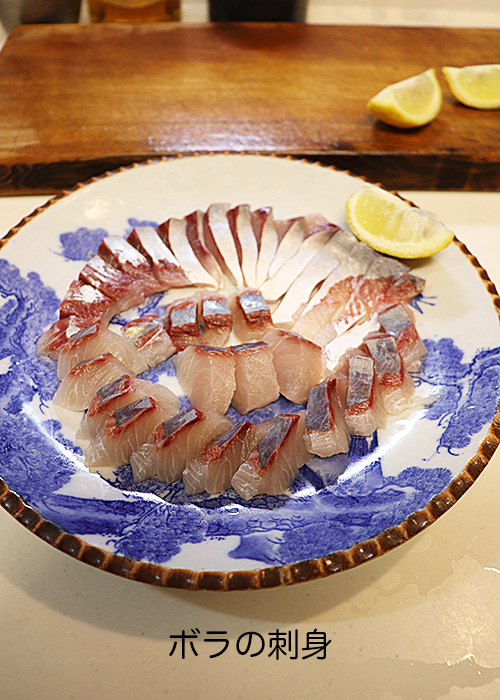
Mullet caught during particularly cold periods is known as “cold mullet” and is considered a special delicacy; it is exceptionally delicious. Furthermore, its ovaries are prized worldwide as bottarga, and the part of the stomach lining known as “mullet’s navel” is also considered a delicacy.
The mullet is an excellent fish to catch. It puts up a tremendous fight.
Also, their spindle-shaped bodies and the way they leap out of the water, splashing as they hit the surface—when I see them “playing” like that on a summer evening, it stirs a certain sentiment in me.
Just like the “Nari-kin” piece in shogi, there are certain fish that are considered special during the winter season. Mullet is one example, and others include “kan-buri” (winter yellowtail) and “kan-buna” (winter crucian carp); and although it’s a shellfish, “kan-shijimi” (winter clams) are also well-known.
By the way, have you ever heard of a fish called “isuzumi”?
This fish resembles the girella, but it seems to be a species native to more southern waters. It’s especially exceptional in winter; as far as I know, everyone on Hachijojima Island heads out to fish for isuzumi when winter arrives. I’ve caught some fine-sized isuzumi there myself, and I was truly impressed—not only did their fight rival that of girella found on this island, but when served as sashimi, they were an absolute delicacy that held its own against Akashi sea bream!
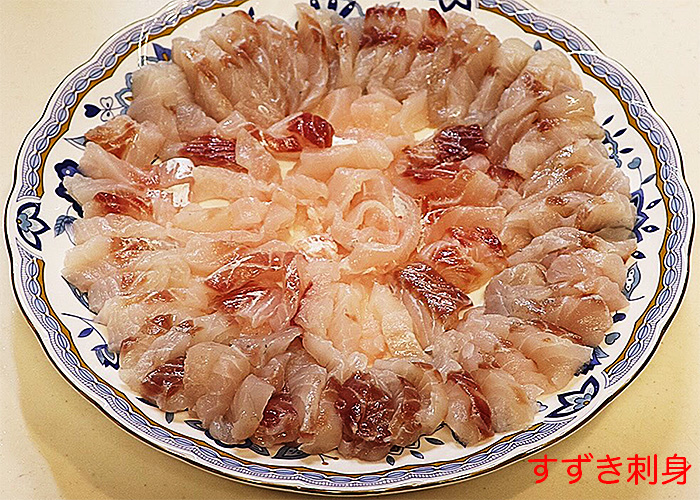
Let’s eat sea bass!
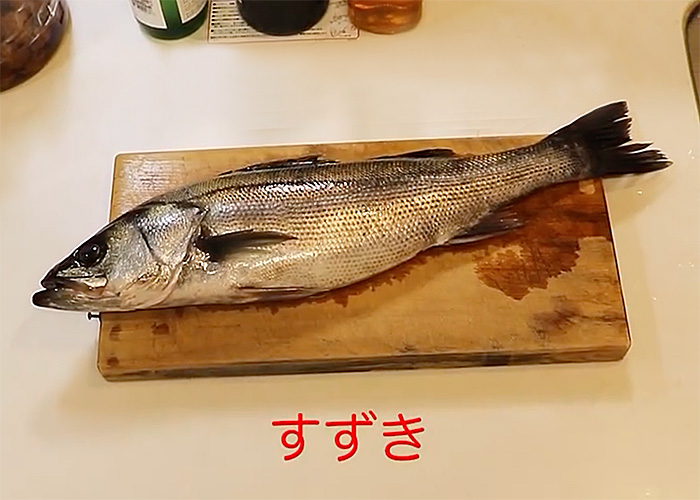
Like the mullet, the sea bass is a fish whose name changes as it grows (a fish that “rises through the ranks”). This likely means that it has long been a familiar fish, easily seen by ordinary people.
Speaking of rising to ranks, before Taira no Kiyomori accomplished his great deeds, it was sea bass who leaped onto the ship he was riding. It’s a famous story, isn’t it?
Something similar happened to me, though on a much smaller scale—what jumped onto the boat I was on was a “seigo.” That’s right, it was a young sea bass. It happened while I was on a sightseeing boat touring the moat of Matsue Castle, a National Treasure located in Matsue City, Shimane Prefecture. The moat connects to Lake Shinji, so it’s mixed with seawater.
“Sea bass in eastern Japan, red sea bream in western Japan”—that’s just my own personal impression, but the reason we don’t say, for example, “eastern mullet” is that its flesh simply doesn’t compare to that of red sea bream; that’s why we refer to it as sea bass. In other words, that’s how delicious sea bass really is.
…But let’s talk about Lake Shinji. Lake Shinji is home to the “Seven Delicacies of Lake Shinji,” and sea bass is definitely one of them. The dish known as “Hōsho-yaki”—sea bass wrapped in Japanese paper and steamed—is a famous local specialty of Matsue(松江). In fact, the name “Matsue” was taken from the Chinese city of “松江,” and apparently, sea bass is also abundant there.
There is also a story that, long ago during the “Transfer of the Land” in Izumo, Takemikazuchi was treated to a feast of sea bass caught in Lake Shinji.
While sea bass are likely most abundant in Tokyo Bay in Japan, given their association with fearsome historical figures from western Japan—such as Taira no Kiyomori and Takemikazuchi—it may not be entirely accurate to refer to them solely as “the sea bass of eastern Japan,” and we may need to reconsider that label.
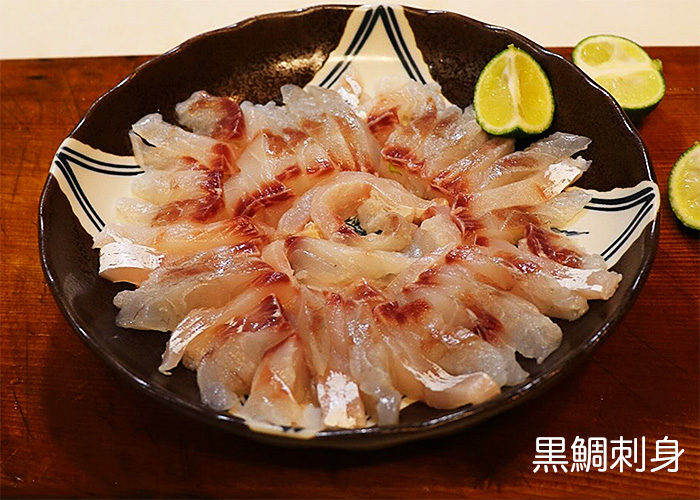
Let's eat black sea bream!
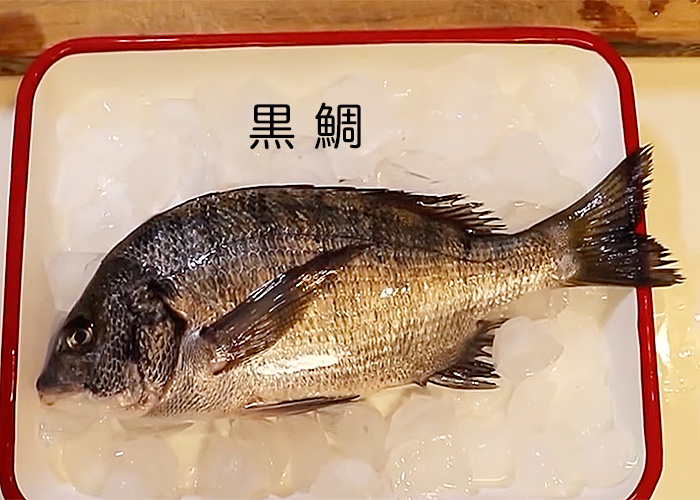
The leader of the side that was forced to “Transfer of the Land” was Okuninushi, and one of his children is the deity Kotoshironushi. This deity is known to the world as Ebisu and is also famous for his great love of fishing; in the paintings and statues of Ebisu that we often see, he is usually depicted holding a sea bream and a fishing rod. Now, while the sea bream is usually depicted as a red one, there is some doubt as to whether it was actually a red sea bream.
In the writings of the great novelist Koda Rohan—who was also famous as an angler—it was mentioned that the fishing rod held by the deity Ebisu is not meant for catching red sea bream, but is instead suited for catching black sea bream. Indeed, since black sea bream venture into brackish waters while red sea bream inhabit relatively deeper waters, the fishing rods used for them naturally differ. Come to think of it, the fishing rod often depicted in depictions of Ebisu does indeed look like one meant for black sea bream.
Perhaps because red simply looks more appealing, and red sea bream tastes better than black sea bream, it came to be seen as a symbol of good fortune—which is why, at some point, red sea bream may have replaced black sea bream.
However, the black sea bream is a bona fide member of the sea bream family. While there are many fish in Japan with “sea bream” in their names—such as “○○ sea bream”—that aren’t actually part of the family, the black sea bream is the real deal. That’s why, personally, I’d like Ebisu to hold the black sea bream—no, I strongly urge him to do so.
The reason is, first of all, that I prefer fishing from shore to fishing from a boat out at sea. Red sea bream is generally caught from a boat. Furthermore, like mullet and sea bass, black sea bream are a familiar presence in our daily lives. For example, they can be found right at our feet in places like Yamashita Park in Yokohama or along the Sumida River promenade. This brings me a sense of wonder and awe, and it reminds me of the importance of feeling a connection to nature and cherishing it.
Furthermore, one could say that black sea bream fishing is distinguished by its refined style. In the old days, black sea bream fishing was apparently a quiet, dignified activity enjoyed while sipping hot tea; consequently, this type of fishing naturally appealed to those who were not coarse in manner. Indeed, I recall reading in the writings of Koda Rohan that Tokugawa Yoshinobu—known as “Keiki-san”—was also fond of black sea bream fishing.
I’ve tried countless times to catch black sea bream. Yet, I still haven’t managed to catch the one I’m really after.
The Real Tokyo : detailed guidebook for Tokyo
I grew up in Tokyo, where the Toden Arakawa Line — also known as the "Chin Chin Tram" — ran nearby. I now live in Kamakura, which also has a streetcar, the Enoshima Electric Railway.
The sound of a streetcar running is a special sound to me, and it brings back a certain nostalgia in my heart.
I often rode the streetcar with my mother to Arakawa Amusement Park. The park is still there today and is located on the banks of the Sumida River. The Otonashi River (also known as the Shakujii River) is a tributary of the Sumida River. Both the elementary and junior high schools I attended were located on its banks.
There was also a small hill called Asukayama nearby. Whenever we went to view the cherry blossoms, we always went to Asukayama. This was back when there was still an observation deck that revolved. It was the highest in the area at the time, so I looked forward to climbing up there.
I later learned that Asukayama was a popular tourist destination for the common people of Edo. Indeed, at the foot of the mountain were the clear waters of the Otonashi River, home to sweetfish. Rows of restaurants and tea shops lined the river, creating a landscape befitting a tourist destination. Furthermore, there was an Inari shrine and a famous waterfall, which made it even more appealing.
There were apparently seven of these famous waterfalls at the time. Today, only one remains: Nanushi Falls. I often splashed around in the water here during the summers of my childhood. However, I remember that the waterfall was rather small back then, far from the image of a famous waterfall.
The Inari Shrine is today's Oji Inari Shrine, and I remember seeing many stone statues of foxes there. There was also a fox den in the cliff that I looked at in amazement.
Later, when I came across Utagawa Hiroshige's "One Hundred Famous Views of Edo," I was overjoyed to discover that it included Asukayama, Oji Inari Shrine, and the fox, as well as several paintings of Oji Falls. At the same time, it was an eye-opener to realize how beautiful Tokyo was during the Edo period.
"One Hundred Famous Views of Edo" contains many waterfront scenes, which is no surprise, as Edo was a "city of water."
It made me realize that heaven or paradise is not somewhere far away, but that it was once right under my feet.
At Lab Deep in Kamakura, we have produced a detailed guidebook to Tokyo, looking at present-day Tokyo while also admiring the Edo-Tokyo of the past. We have titled it "The Real Tokyo." Please check it out below.
Lab Deep in Kamakura Juei Masuda